Home / Blog / Industry News / Jacquard Knit vs Sublimation Printed Socks: Which Is Better for Your Brand
Jacquard Knit vs Sublimation Printed Socks: Which Is Better for Your Brand
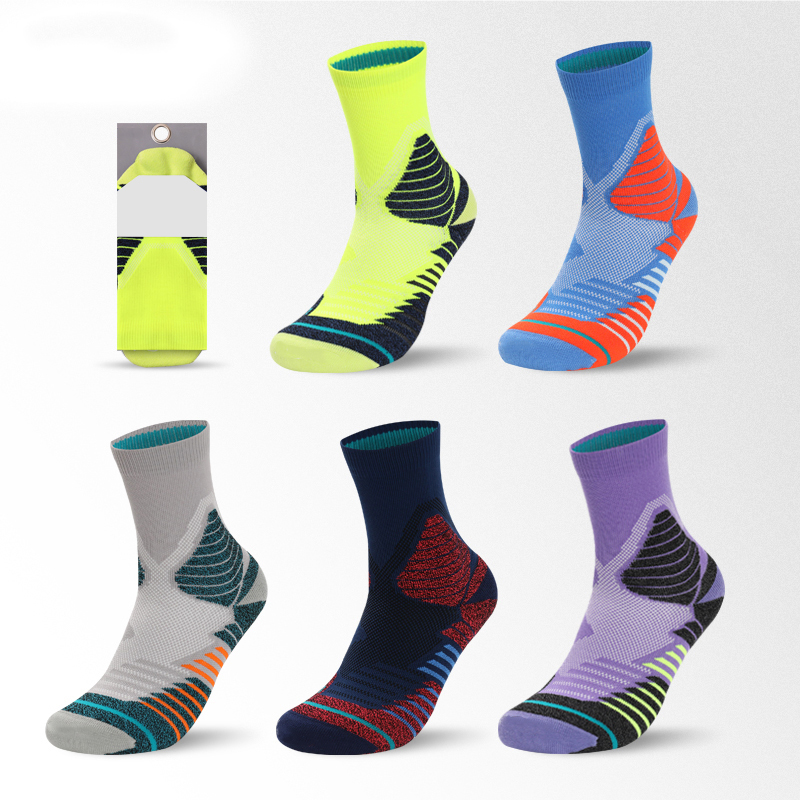
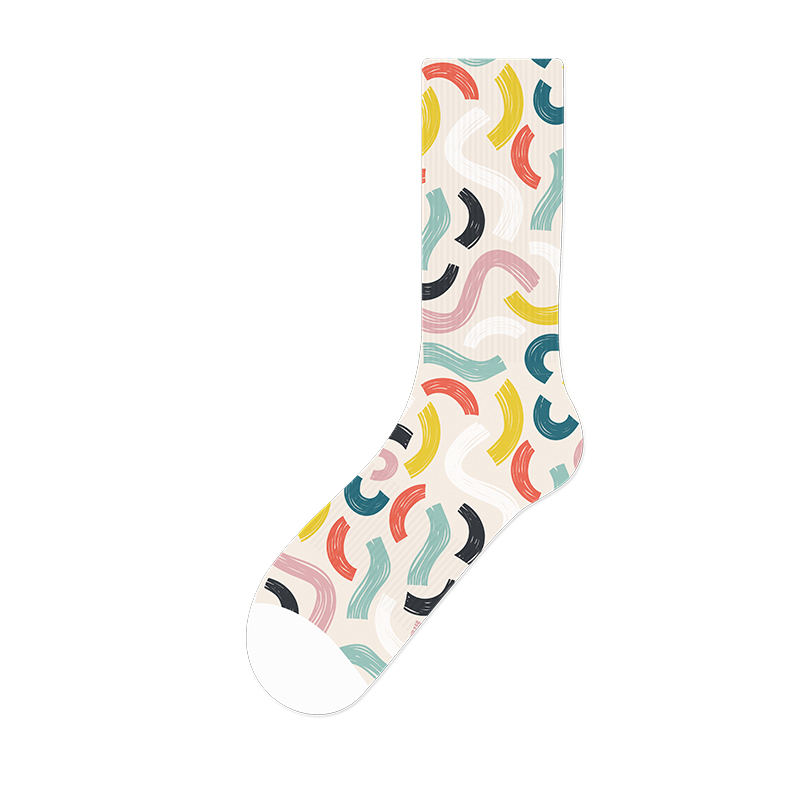
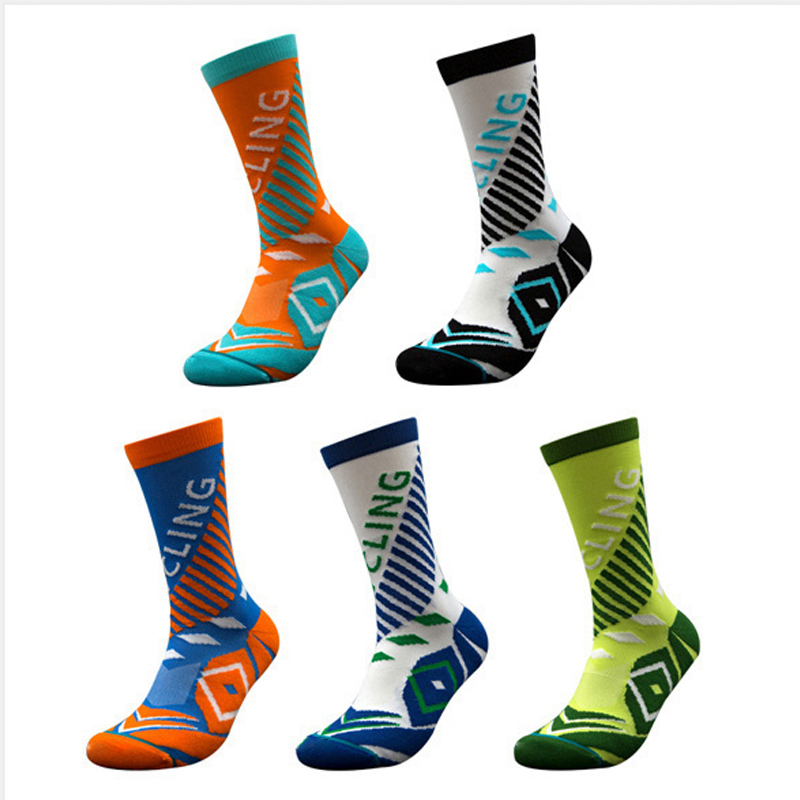
Take two finished socks out of the same sample bag. One is a bright cycling sock with a large geometric logo, and the surface feels textured, almost like a fine woven fabric. The other is an all-over printed sport sock covered with a photographic gradient, smooth to the touch and noticeably thinner where the pattern wraps around the instep. Both cost around a similar price at production level, and both pass the first visual check. But after twenty industrial washes, their behaviour starts to diverge sharply. The knitted sock keeps its pattern because the colour is part of the yarn itself. The printed sock loses saturation at the toe and heel, and faint white creases appear wherever the fabric was stretched during printing.
For a sock manufacturer that runs jacquard knitting machines and sublimation printing lines side by side every day, the answer to the common question "Which is better?" is not a single word. Jacquard knitting is the better method when durability, stretch recovery, fabric hand feel and structural patterns matter. Sublimation printing is the better method when you need photographic detail, unlimited colour gradients and full-surface artwork that knitting cannot reproduce. Everything else depends on your product type, the target price of the finished pair and your quality control standard.
This article compares the two methods from a production point of view: how each one is made, how they behave after repeated washing and stretching, what they cost at scale, and which sock categories are best suited to each process. If you are a brand owner, an importer or a retail buyer planning your next sock programme, this will help you make the method decision before you commit to a factory.
What Is Jacquard Knitting?
Jacquard knitting is a machine knitting technique that builds the pattern into the fabric while the sock is being knitted. On a circular sock knitting machine, the computer-controlled needle cylinder selects which yarn is shown on the face of the sock at every single stitch. When a design requires a blue logo on a white background, the machine switches between blue yarn and white yarn course by course. The yarn that is not used is carried on the reverse side or tucked in, which is why most jacquard socks have a slightly thicker structure and a clean, woven-like pattern on the outside.
At our workshop in Zhuji Datang, jacquard production runs mainly on high-speed circular sock machines with electronic needle selection. The pattern is prepared in the programming department, converted into a machine file, and then read by the cylinder needles. This means the pattern is not a coating and not a lamination: the coloured thread exists inside the wall of the sock. If you cut a jacquard sock open, you can see the coloured yarn passing through the cross-section of the fabric.
This construction explains the performance benefits. Because the pattern is part of the knitted loops, it cannot peel, crack or flake. When the sock is stretched, the pattern stretches with it, because the same yarns move together. Abrasion from shoes or rough ground wears the yarn surface itself, but the colour continues all the way through, so a jacquard pattern remains readable much longer than a surface print.
The main limitations are equally clear. A jacquard design is usually limited to three to six yarn colours in a pattern area, and true gradients or photographic images are not possible. Heavy all-over jacquard also adds yarn and machine time, so the sock becomes slightly heavier and the knitting speed drops. In exchange, you get one of the most durable socks available.
Pattern cannot peel, crack or fade away because it is knitted in
The design stretches and recovers together with the fabric
Works with cotton, nylon, wool, bamboo and spandex blends
Textured, full-bodied hand feel that most buyers associate with premium quality
Suitable for terry cushioning, compression zones and reinforced toe and heel areas
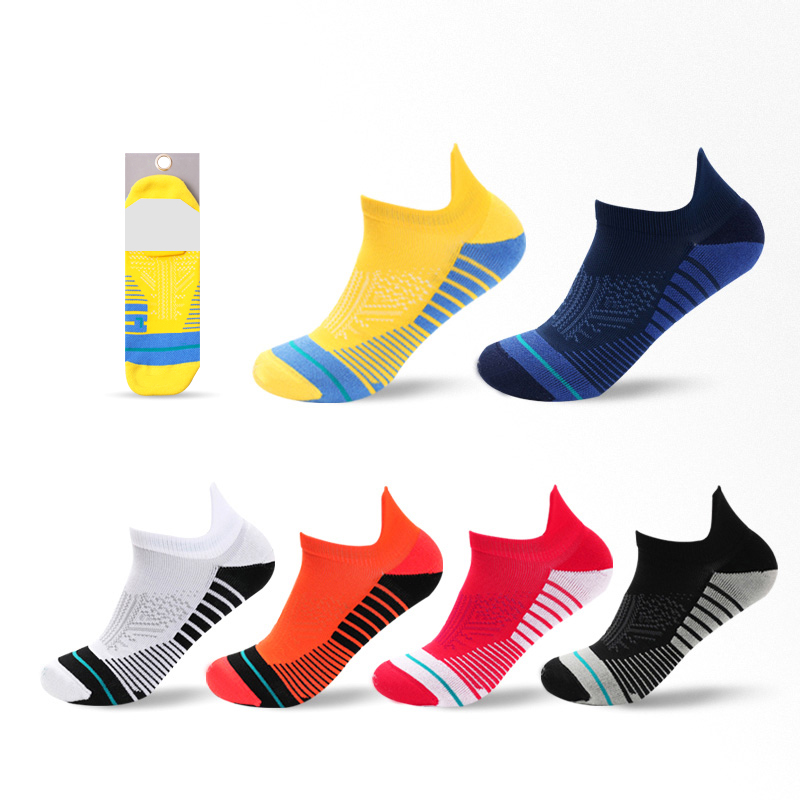
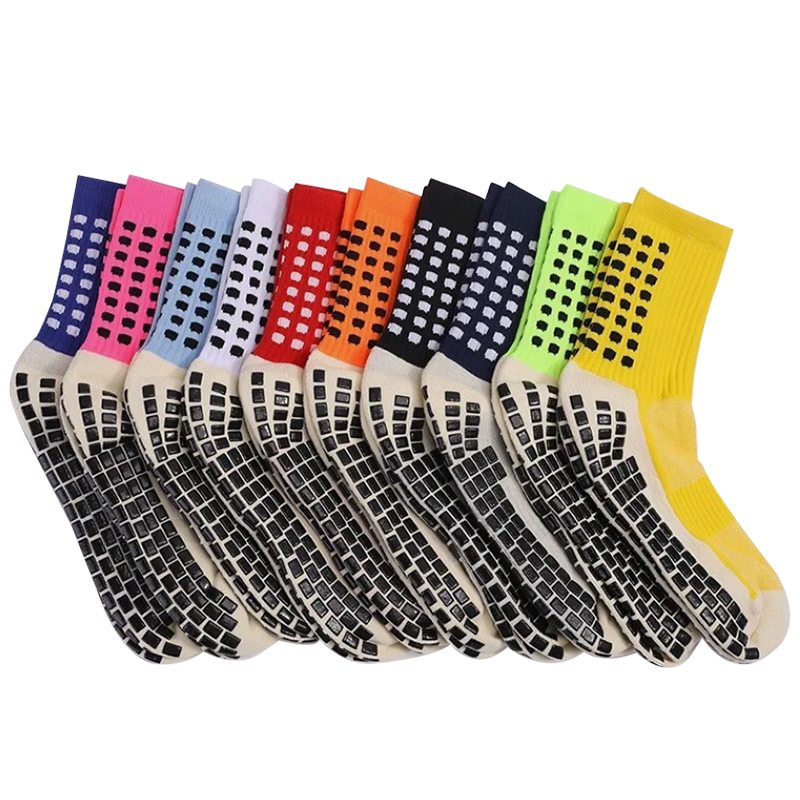
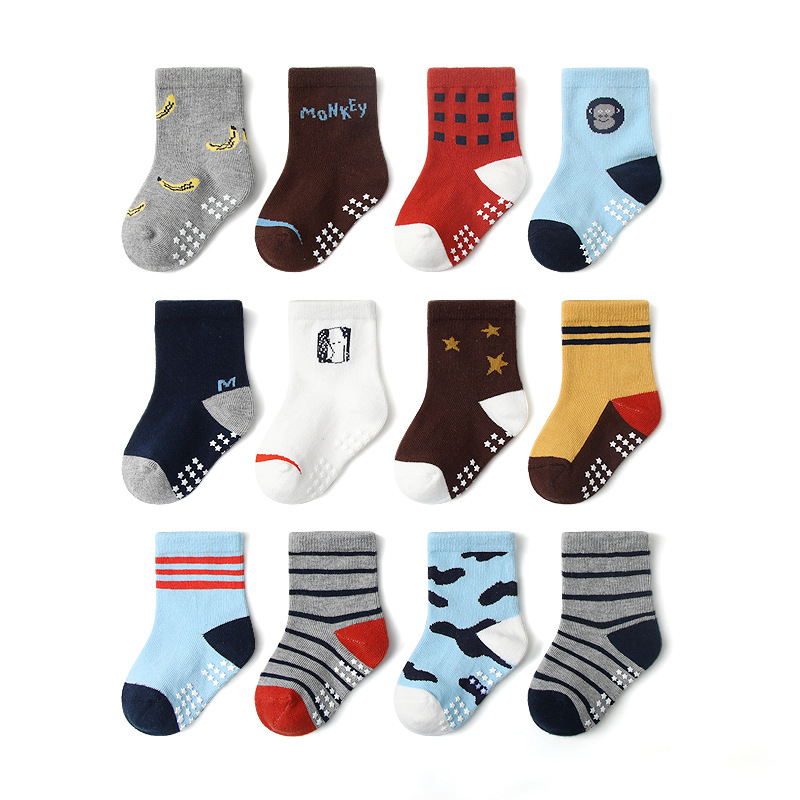
Typical examples in our catalogue are bright jacquard basketball terry socks, outdoor cycling compression socks, jacquard football socks with a non-slip bottom and street-fashion jacquard socks. If you want to understand how a simpler knitted structure differs from jacquard, our article on what flat knit socks are and how they are made explains the construction in more detail.
Sublimation printing is a heat-transfer colouring process, not a knitting process. The artwork is printed onto transfer paper with disperse dyes. The printed paper is then placed against the sock, and the combination is passed through a heat press or a continuous tunnel at roughly 200 to 220 degrees Celsius. At that temperature, the solid dye turns directly into gas and bonds with the polyester fibres on the surface layer of the sock. When the fabric cools, the dye becomes solid again inside the fibre.
The critical material condition is polyester content. Disperse dye only bonds with polyester or other synthetic fibres that accept it. Cotton, wool and most natural fibres stay white or very pale after sublimation. This means a sock with 60 percent cotton and 40 percent polyester will not reproduce the artwork faithfully: the cotton areas will look washed out and much lighter than the design on the monitor. For reliable sublimation results, we recommend at least 70 to 80 percent polyester in the yarn blend, and for bright all-over designs, a fully polyester construction is safer.
The strength of sublimation is design freedom. There is no limit to the number of colours, and gradients, shading, small text, photo images and halftone effects are all reproduced at high resolution. Because the transfer paper carries the complete design, changing from one artwork to the next is fast and does not require re-programming a knitting machine. This makes sublimation attractive when a brand wants an aggressive all-over print, a marble or camouflage effect, or a separate design for every colourway in the collection.
The weakness of sublimation lies in what happens to the surface layer of the fabric. The dye bonds mainly with the outer part of the yarn and the outer face of the fabric. When the sock is stretched hard, the un-dyed core of the yarn or the un-dyed back layer can show through as white lines. Over many wash cycles, especially industrial washing with aggressive detergent and high temperature, the surface layer slowly loses intensity, and the pattern looks less saturated even though the base fabric remains intact.
Full CMYK colour with photographic and gradient art
All-over patterns, including toe and sole areas where knitting would be impossible
Fast design changes: new transfer paper, no machine re-programming
Requires polyester-dominant yarn, at least 70–80 percent
High heat can affect spandex and elastane in the structure
In our production line, 3D digital printed socks and flat digital printing styles are typical sublimation products, usually made from polyester yarn with a brushed or mesh structure to improve the printed surface.
The table below compares both methods across the factors that matter most when you plan a sock order. The scores are based on how the two constructions perform in our own production and lab washing tests, not on a theoretical marketing description.
Side-by-side comparison of jacquard knit and sublimation printed socks across production and performance factors (manufacturer assessment, scale of 1–10).
Comparison Factor
Jacquard Knit
Sublimation Printed
Pattern formation
Pattern knitted into the fabric with coloured yarn
Dye transferred onto the fabric surface by heat
Number of colours
Usually 3–6 yarn colours per design area
Full CMYK, effectively unlimited
Photographic and gradient art
Not possible
Excellent
Durability after 50 washes
High; pattern is part of the knitted structure
Moderate; surface layer slowly loses saturation
Stretch behaviour
Pattern stretches with the fabric, no white lines
White crease lines can appear when over-stretched
Hand feel
Textured, full-bodied, premium
Smoother and flatter; depends on base yarn
Material compatibility
Cotton, nylon, wool, spandex blends
Requires at least 70–80% polyester content
Spandex safety
Safe; no exposure to high heat
Heat can degrade elastic properties
Minimum order quantity
Flexible; a few hundred pairs feasible
Higher for efficient running cost
Production speed
Slower; needle selection and yarn changes
Faster after transfer printing is set up
Cost per pair at scale
Medium
Low to medium on polyester yarn
Best suited for
Sports, terry, compression and fashion jacquard
Photo patterns, all-over prints, novelty fashion
Reading the table correctly is more important than memorising it. Jacquard scores high wherever mechanical stress is involved: washing, stretching, rubbing, bending at the heel and toe. Sublimation scores high wherever visual complexity is involved: colours, gradients, textures that look like photography. The right choice depends on which side of the scale your product needs.
Durability, Stretch and the White-Line Problem
The most common quality complaint about printed socks is not that the print disappears completely, but that the design looks tired after a few months. With jacquard, this complaint almost never appears, because there is no independent print layer that can age separately from the fabric. The yarn itself carries the colour. In our wash tests, a jacquard sock made with nylon and spandex keeps its visual density at the heel, toe and instep after fifty industrial machine washes at 40 degrees Celsius. The only visible change is a slight softening of the terry loops and a small loss of surface fuzz, not a loss of pattern.
Sublimation behaves differently. The dye molecules penetrate the outer layer of each polyester fibre, but the fibre core remains un-dyed. Under normal wearing, this is invisible. When the sock is stretched hard at the ankle, heel or toe, the un-dyed core and the un-dyed backing yarns can appear as thin white lines on the pattern. The industry calls this the white-line effect, and we demonstrate it to every client before they place a print order. The same effect appears when the sock is pulled over a shoe horn or stretched during packing.
The white-line effect is not a defect of the printing process itself. It is a physical limit of any surface-colouring method. If your design and your fit both require high stretch at the ankle, the white lines will appear at some point. For compression socks, cycling socks and football socks that are pulled tight around the calf, jacquard avoids this problem completely, because the coloured yarn extends through every loop of the structure.
Colour retention after repeated washing
Visual rating by our lab team after machine washing at 40°C (10 = as new, 1 = severely faded)
Jacquard knitSublimation printed
Source: inside-lab wash tests on our production samples, both socks knitted with the same polyester blend base yarn.
Colour Range and Design Freedom
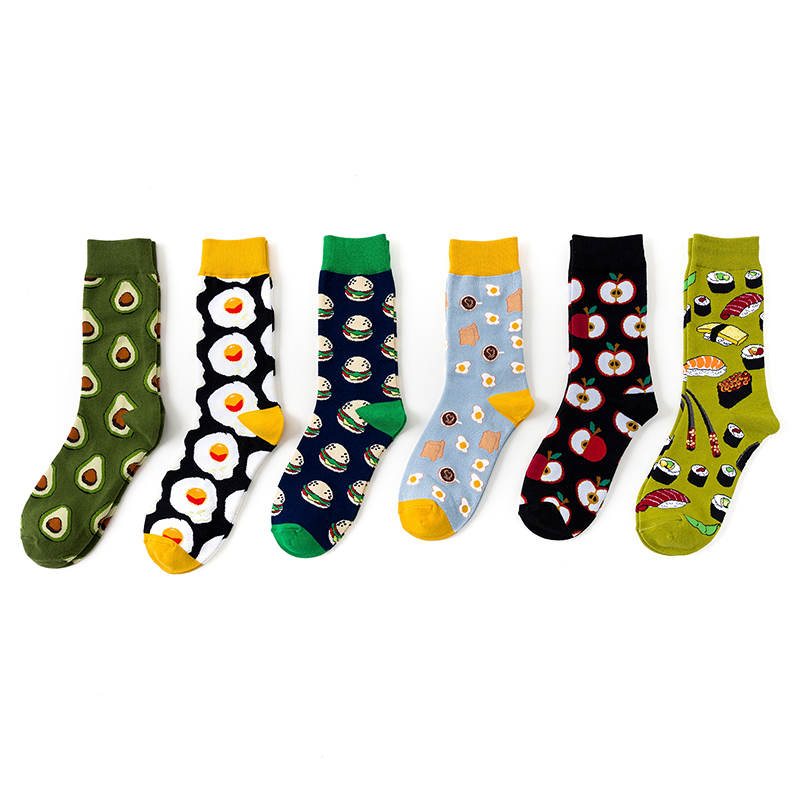
If your artwork is a simple logo, thick letters or geometric blocks, jacquard can handle it beautifully and give it a crisp, three-dimensional look. The raised surface of the yarn pattern adds a tactile dimension that a flat print cannot copy. This is why many team sport socks use jacquard for the club crest and the side stripes: the crest looks woven, not applied, and it stays sharp at every size in the range.
If your artwork depends on gradients, shadows, airbrush effects or photographic faces, jacquard simply cannot reproduce it. A jacquard machine builds each colour from a separate yarn, so a face with twenty shades of skin tone is not feasible. Sublimation turns this kind of design into a routine job. We routinely print galaxy patterns, marble textures, tropical leaves and complex cartoon characters on polyester sport socks. The resolution is high enough for small text at the ankle, and the material is not thickened by the print.
There is also a middle path that many brands miss. A sock can be knitted with a jacquard structure and then over-printed with a small sublimation area where an extra design needs to sit, such as a photo patch on the calf or a gradient at the cuff. We call this a hybrid sock. It costs more than either single method, but it solves the colour gap without giving up the durability of the knitted base. If you are planning a premium product, this is worth discussing with the factory before the artwork is finalised.
Cost, MOQ and Production Efficiency
Many buyers compare the cost per pair on a quotation sheet and stop there. The real cost difference between jacquard and sublimation is not only in the unit price; it is also in the minimum quantity, the sample lead time, the machine running time and the labour involved in each order stage.
Jacquard has a lower practical minimum order because there is no paper printing step and no heat-press step. A small run of two or three hundred pairs is feasible, especially when the new design is similar to an existing jacquard file. The cost lies in the knitting time and the programming work. Once the machine starts, the pattern quality is consistent across every pair, which reduces the inspection workload.
Sublimation has a very low cost per printed transfer once the design is set, and the tunnel process runs at a continuous speed, so large quantities are efficient. However, the transfer paper, the printing labour and the heat-press energy are fixed costs per order. If the quantity is small, these costs push the unit price up. For a brand that needs only two hundred pairs per style across forty styles, sublimation can be more expensive than jacquard. For a brand ordering five thousand pairs of one all-over design, sublimation usually wins on price.
Capability comparison: jacquard vs sublimation
Scores are reference ratings from our production and quality teams (1–10, higher is better).
Colour range
Jacquard
Sublim.
Durability
Jacquard
Sublim.
Stretch recovery
Jacquard
Sublim.
Hand feel
Jacquard
Sublim.
Design detail
Jacquard
Sublim.
Small-batch flexibility
Jacquard
Sublim.
Ratings are relative and based on the most common sock constructions in our product range.
Another production factor is sampling time. A jacquard sample requires a machine file, yarn setting and a test run, which normally takes three to seven days depending on the pattern complexity. A sublimation sample requires only the artwork file and a printed transfer, so a physical sample can be ready within one to two days. If you are chasing a trade show deadline, sublimation is faster at the sample stage. If you are building a long-term programme with repeat orders, jacquard is faster at the production stage, because there is no separate printing and heat-press line in the workflow.
How to Choose the Right Method
The decision becomes straightforward if you separate the artwork from the use condition. Ask two questions: what is the design asking for, and where will the sock be used? The cards below give you a quick filter before you send an enquiry to the factory.
Choose jacquard knit when
Durability is the main priority: sports, training, work and team socks
The design uses strong logos, stripes, colour blocks or geometric shapes
The sock needs spandex for compression or a tight fit at the ankle
You want a textured, premium hand feel instead of a flat surface
The order quantity is medium and the same design repeats for seasons
You need a reinforced terry sole or a non-slip bottom that interacts with printed surfaces
Choose sublimation printing when
The artwork is photographic or contains smooth gradients
You need an all-over shell pattern covering the entire sock
Your range contains many small designs and frequent colour updates
The base yarn is polyester or a polyester-dominant blend
Speed matters more than absolute durability in the end-use
You accept that very high stretch areas may show white lines after hard pulling
Basketball socks Jacquard Toe and heel abrasion is constant, and terry cushioning is easier to knit than to print.
Cycling compression Jacquard High spandex content is sensitive to heat; the print layer can crack under calf pressure.
Football socks Jacquard Long tube, repeated pulling and shin guard friction require a pattern that does not lift.
3D digital print athleisure Sublimation Multi-colour all-over art is the selling point, so print fidelity matters most.
Fashion street socks Either A jacquard hip-hop pattern is durable; a photo print gives more visual impact.
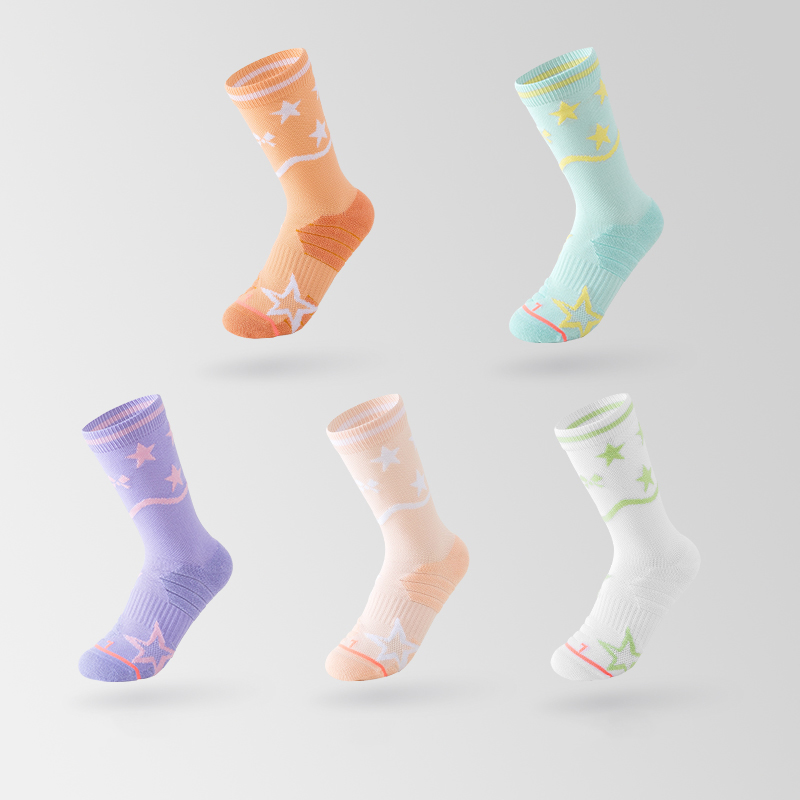
Kids and cartoon socks Sublimation Full-colour faces and animal graphics need a CMYK process.
Tie-dye effect socks Sublimation Gradient colour flow is not reproducible with separate yarn colours.
Christmas and seasonal socks Jacquard Traditional patterns use block colours, and seasonal spreads repeat year after year.
Material Compatibility and the Spandex Risk
Material choice is the silent partner in this comparison. Jacquard knitting does not care whether the yarn is cotton, nylon, wool, bamboo, polyester or a spun blend. The pattern is formed by the yarns themselves, and the yarn composition only affects the feel and the function of the sock. This is a significant advantage for sport socks, where a nylon outer layer gives strength and a cotton inner layer gives moisture absorption. A jacquard football sock can combine nylon and cotton in the same knitted structure without any additional finishing step.
Sublimation printing is much more demanding. Disperse dye needs polyester, and it needs enough of it. In our experience, a sock with 60 percent cotton and 40 percent polyester produces a washed-out, pastel version of the artwork, which surprises many first-time buyers. The practical rule is 80 percent polyester minimum for saturated colours, and 100 percent polyester for bright all-over designs. This restriction changes the hand feel of the finished product: a fully polyester sock is smoother, less absorbent and less breathable for casual wear than a cotton-rich sock.
The second risk is heat damage to elastic yarns. Sublimation is carried out at roughly 200 degrees Celsius. Spandex and elastane yarns begin to lose their elastic recovery when exposed to such temperatures for too long. If the printing tunnel runs hot or the dwell time is too long, the finished sock will look correct but the ankle will stretch out after a few wears. This is why compression socks and cycling socks with a high spandex content are almost always produced as jacquard or as knitted compression structures rather than sublimation printed. In our catalogue, the outdoor cycling pressure nylon jacquard sock is the direct answer to this problem: the pressure zones are knitted, not printed, so the elastic function is never compromised by heat.
If you still want a printed effect on a spandex-based sock, the safe route is to print the dye onto a polyester panel first and then sew or knit that panel into the sock. That is how some all-over print football socks with a tight calf are made. The process is slower and more expensive, but it protects the elastic performance. Always tell the factory the exact spandex content before the process is fixed; do not assume that a pretty printed sample will behave the same way when the elastic content changes.
Which lasts longer: jacquard or sublimation printed socks?
Jacquard lasts longer. Because the pattern is knitted from coloured yarn, it survives abrasion, repeated washing and stretching much better than a printed surface layer. In our wash tests, jacquard retains a higher visual rating after 50 industrial washes than sublimation printing on the same base yarn.
Can sublimation printing be used on cotton socks?
No. Disperse dye only bonds with polyester fibres. Cotton areas stay white or very pale. For reliably saturated colours, the sock needs at least 70 to 80 percent polyester content. Cotton socks should use jacquard, embroidery, screen printing or another surface decoration method instead.
Does sublimation printing damage spandex?
It can. The printing process runs at around 200 degrees Celsius, and spandex loses elastic recovery when exposed to excessive heat. If the spandex content is high, or if the sock needs a tight compression fit, jacquard is the safer method. If a printed look is essential, the print should be applied to a polyester panel before assembly.
Why do printed socks show white lines when they are stretched?
Because the dye only penetrates the outer surface layer of the fabric. When the sock is stretched, the un-dyed fibre core or the backing yarns become visible as thin white lines. This is a physical property of surface dyeing, and it is most noticeable at the ankle, heel and toe during fitting.
How many colours can a jacquard sock have?
In practice, three to six yarn colours in one pattern area are common. More colours are possible on advanced machines, but each additional colour increases the yarn carrier count and slows the machine. If the design needs more than six colours or a gradient, sublimation is the better process.
Can jacquard and sublimation be combined in one sock?
Yes. A common hybrid is a jacquard knitted body for durability and fit, with a small sublimation printed area, such as a photo patch or a gradient panel. The hybrid costs more than either method alone, but it delivers the full-colour effect without sacrificing the knitted performance.
What is the real difference in minimum order quantity?
Jacquard is more flexible for small orders, because the cost is in machine programming and knitting time. Sublimation requires transfer paper, printing labour and heat-press setup, so very small orders have a higher unit cost. For large quantities, sublimation becomes more efficient and can reach a lower cost per pair on polyester yarn.
What We Recommend as a Manufacturer
After producing millions of pairs of both types, we do not recommend one method as universally better. We recommend that the method follow the product. If you are developing a performance sock for basketball, football, cycling, running or outdoor use, choose jacquard. The pattern will stay sharp, the sock will keep its fit around the ankle, and your customer will not complain about peeling or white lines. If you are developing a fashion-led sock where the artwork is the hero, choose sublimation and build the product on a polyester base so the colours reach their full intensity.
The most important step is to send the actual artwork and the target price to the factory before the production method is locked. A good factory will tell you honestly when your artwork is not suitable for jacquard, or when your elastic requirement is not safe for sublimation. Our production floor in Zhuji Datang runs both jacquard knitting machines and sublimation printing lines, with a daily output capacity of around 80,000 pairs, so we can switch between methods without bias. The product requirement decides the process, not the other way round.
If you are comparing samples from different suppliers, ask for wash tests, stretch tests and a cross-section cut of the finished sock. A jacquard sock shows coloured yarn inside the wall. A sublimation sock shows a white core inside the yarn. That one simple cut tells you more than any specification sheet. And when you are ready to move, send your designs and your target quantity through our contact page, and we will recommend the method, produce a sample and give you a clear cost breakdown before anything is committed.

 English
 Español