You get home after a ten-hour day, pull off your shoes, and peel away a pair of socks that feel heavy, damp and slightly stretched at the heel. If that pair carried a "100% cotton" label, you have already experienced both sides of this fibre: the soft, calm comfort you enjoyed all morning, and the wet, shapeless weight you noticed by evening.
Here is the short answer before anything else. Yes, 100% cotton socks are good - genuinely good - for everyday low-sweat wear, for sensitive skin, for babies and toddlers, for office shoes, for sleeping and for time at home. No, they are the wrong tool for running, court sports, long hikes in variable weather, and any situation where sweat or rain has nowhere to go. Cotton is not a "better" or "worse" fibre than synthetics or wool; it is a different fibre with a different job. The trouble starts when one material is asked to do every job at once.
We look at this question from an unusual position. As a sock manufacturer based in Datang, Zhuji - a town that has built its whole economy around hosiery - we knit soft cotton styles and technical performance blends on the same factory floor, and we see every week which customers come back happy with each choice. This guide collects what that daily experience teaches, so you can decide with confidence instead of guesswork.
The quick verdict
- Choose 100% cotton socks when comfort, skin-friendliness and breathability matter more than fast drying: daily wear, office shoes, bed socks, baby socks, travel and lounging.
- Think twice when sweat, rain or multi-hour activity is involved: wet cotton holds moisture against the skin, dries slowly, and raises the risk of blisters and cold feet.
- Check the fine print: many socks labelled "100% cotton" carry a small amount of elastic only in the cuff, which is usually acceptable - and usually necessary.
What "100% Cotton" Really Means on a Sock Label
In theory the label is simple: every fibre in that sock came from a cotton plant. In practice, anyone who has stood next to a sock knitting machine knows the story is more layered. A sock has to stay up on the leg, recover after every step, and survive thousands of rubbing cycles inside a shoe. Cotton fibre on its own has almost no natural elasticity - stretch it and it stays stretched.
That is why the vast majority of cotton socks rely on a thin plating of elastane or elastic yarn somewhere in the structure. Several labelling systems around the world allow the small amount of elastic used only in the cuff to be excluded from the fibre declaration; other markets require every fibre to be listed. So one brand's "100% cotton" can mean a fully rigid knit, while another's means a cotton body with an elastic ribbing hidden in the top. Neither is dishonest, but the two socks behave very differently after a few hours of wear.
A truly rigid, all-cotton sock does exist, and it has legitimate homes: hospital-style loose-top socks, aviation socks, and certain medical designs where a completely elastic-free cuff matters more than a snug fit. But for everyday use, expect an elastic-free cotton sock to slouch at the ankle and wrinkle under the foot - and wrinkling inside a shoe is precisely what creates friction and hot spots.
Carded, Combed, Mercerized: Not All Cotton Yarns Behave the Same
The second thing the label will not tell you is the grade of the cotton yarn. Two socks can both say "100% cotton" while one pills after three washes and the other still looks clean-edged after thirty. The difference is made upstream of knitting, in the spinning mill.
- Carded cotton keeps its natural mix of fibre lengths, including short ones. It is affordable and soft at first touch, but the short fibres work loose under friction and turn into pills.
- Combed cotton passes through an extra combing step that removes the short, loose fibres. The result is a smoother, stronger, more even yarn that resists pilling and feels cleaner against the skin. For anything worn against bare skin all day, combing is worth the cost.
- Mercerized cotton is treated with caustic soda under tension, which swells the fibre and gives it a subtle lustre, better dye uptake and higher strength. It appears mostly in dress and fashion socks.
- Extra-long staple cotton uses noticeably longer fibres, which spin into finer, silkier and more durable yarns - the tier you feel immediately in a premium dress sock.
- Organic cotton refers to how the plant was grown rather than how the yarn performs. Wearers choose it for environmental and skin-sensitivity reasons; mechanically it behaves like its conventionally grown equivalent.
Table 1: The same cotton plant can become very different socks - the spinning route decides softness, strength and pilling behaviour.
| Yarn type |
What the mill does to it |
What your feet actually feel |
| Carded cotton |
Basic cleaning and spinning; short fibres retained |
Soft at first, pills faster, slightly fuzzy surface |
| Combed cotton |
Short fibres combed out before spinning |
Smoother, stronger, stays neat through many washes |
| Mercerized cotton |
Caustic soda treatment under tension |
Subtle sheen, deeper colour, crisper hand feel |
| Extra-long staple |
Spun from long-fibre cotton varieties |
Fine, silky, premium softness with better durability |
| Organic cotton |
Grown without synthetic pesticides; processed like standard cotton |
Same comfort as conventional cotton of equal grade |
Where 100% Cotton Socks Genuinely Earn Their Place
Cotton's strengths line up almost perfectly with low-intensity, comfort-first situations. This is not a consolation prize; for a large share of the hours in a normal week, these are exactly the conditions most feet live in.
Skin comfort for sensitive feet
Cotton is a natural cellulose fibre, and for many wearers that translates into a calmer experience on the skin: no synthetic clamminess, no static cling, and a soft, matte hand feel that leather-lined shoes do not fight against. People with eczema-prone or easily irritated skin frequently report preferring natural fibres next to the skin, and cotton is the most affordable and widely available of them. Two construction details matter as much as the fibre here: a hand-linked, flat toe seam that leaves no ridge across the toes, and a cuff with gentle, even pressure rather than a tight elastic band.
This is also where "100% cotton" earns its strongest claim - hypoallergenic behaviour. Cotton rarely triggers contact reactions, it tolerates repeated hot washing for hygiene, and it does not melt under a hot iron or accidental heat exposure the way synthetic fibres can.
Babies, toddlers and anyone with thinner, more reactive skin
Infant skin is thinner, more permeable and slower to regulate temperature than adult skin, which is why paediatric textile guidance almost always starts with soft, breathable natural fibres. Cotton fits that brief completely: it breathes in a warm cot, washes cleanly at hygiene-friendly temperatures, and softens further with every wash rather than stiffening. What separates a good baby sock from an average one is detail work - a seamless or outward-linked toe, a cuff wide enough not to ring the ankle, and yarn smooth enough not to rub new walkers' skin.
Recommended range Baby Socks Soft cotton baby socks knitted with gentle, non-binding cuffs and smooth toe seams - the details that matter most on brand-new skin, from first size up through toddler. View the baby socks range
Offices, flights and evenings at home
Eight hours in leather dress shoes is a low-sweat, moderate-temperature microclimate, and cotton handles it gracefully. The fibre feels temperature-neutral rather than chilly or clammy, it is quiet inside firm shoe uppers, and combed cotton dress socks hold a crisp rib all day when the cuff carries its hidden elastic. The same logic covers long flights and evenings on the sofa: warm, dry environments with no moisture shocks.
Our own company history began exactly in this territory. The factory was built in December 2003 to knit disposable airline socks - a pure-cotton job where the wear window is short, hygiene matters more than moisture cycling, and softness is the entire product. Capacity has since grown from 15,000 pairs a day to around 80,000 pairs a day across far more categories, but that cotton-first origin still shapes how we judge hand feel.
Recommended range Men's Business Socks Combed cotton dress socks with a smooth flat-knit finish and an elastic that holds from the first meeting to the last train home. View the business socks range
The Honest Drawbacks - and Why They Start at the Fibre
Now the other half of the answer, because the drawbacks of 100% cotton socks are real, predictable and rooted in the physics of the fibre itself.
The moisture problem, in numbers
Cotton is a hydrophilic fibre: its structure absorbs water into the fibre interior rather than letting it sit on the surface where it can evaporate quickly. Textile engineers measure this with standard moisture regain - how much water a fibre holds from the air under controlled conditions. Cotton sits around 8.5%, wool roughly double that but managed very differently by the fibre's structure, and polyester under 0.5%. In practical terms, once you sweat hard or step in water, soaked cotton can hold many times its own dry weight - a multiple so dramatic that outdoor circles commonly quote figures in the tens. All of that water then has to evaporate out through the fibre itself, which is why a soaked cotton sock can stay clammy for hours.
That trapped moisture explains nearly every complaint about cotton in active use. Skin that stays damp softens and macerates, and softened skin under friction is how blisters form. The damp microclimate is also friendlier to the bacteria that produce odour - the cotton fibre itself does not smell, but the moisture it holds gives odour-causing bacteria exactly what they need. Some of the engineering that counters this is explained in our article on how double-layer thermal socks keep your feet dry: managing where moisture sits, rather than pretending it does not exist.
Standard moisture regain by fibre (approximate textile-industry values)
Woolabout 16%
Cottonabout 8.5%
Polyesterunder 0.5%
Notice what the chart does and does not say. High regain is not automatically bad - wool holds more water than cotton yet feels drier against skin because of how its fibres manage it. Cotton's problem is the combination: it absorbs readily, releases slowly, and offers no structure to keep that moisture away from your skin. For sweaty feet, this is the single most important fact in this entire article.
Shape recovery, abrasion and shrinkage
The second cluster of drawbacks is mechanical. A cotton sock without elastic support bags at the ankle within hours. Under repeated abrasion, the first place to fail is almost always the heel and the toe cap, where loop density is highest and rubbing is constant. Short-staple carded yarns add pilling to the list. And cotton knit shrinks: a sock that was not properly pre-shrunk or compacted can lose a noticeable slice of its length in the first hot wash. None of these flaws is inevitable - each one is a specification choice made before the yarn ever reaches the machine.
Up to 27xA widely quoted outdoor-industry figure for how many times its own dry weight soaked cotton fibre can hold in water
3-5%Typical shrinkage of a cotton knit sock that was not pre-shrunk or compacted, after its first hot wash and dry
1-3%Elastane usually plated into the cuff and body so a cotton sock keeps its shape through a full day of wear
From the knitting floor
In our own wear and abrasion checks, fully carded 100% cotton heels are consistently the first point of failure - the loop crowns thin out, then open into a hole, long before the leg fabric shows any wear. When we build a cotton sock meant to last, the answer is rarely "more cotton"; it is combed yarn, a reinforced heel and toe in a denser loop structure, and controlled compacting so the sock keeps its size through the wash cycle. Fibre percentage is one line of a specification, not the specification itself.
Cold and wet is where cotton becomes risky
Dry cotton insulates respectably. Wet cotton does the opposite: the water it holds conducts heat away from skin far faster than air, which is why hikers have warned for generations that cotton is a poor companion in cold, damp conditions. Wet cotton socks on a winter walk are not merely uncomfortable - they measurably accelerate heat loss from the feet. This is the one scenario where we would steer you away from cotton outright rather than merely note its limits.
Choosing by Activity: A Practical Suitability Map
General rules are useful, but most people buy socks for specific days. The chart below condenses our manufacturing and wear-testing experience into a simple score for each situation - how well pure cotton serves that activity relative to the best fibre choice for it. Treat it as guidance, not gospel; fit and construction shift every number by a point or two.
How well 100% cotton socks suit each activity (10 = ideal choice, manufacturer's guidance)
Sleeping and lounging10 / 10
Everyday city wear9 / 10
Baby and sensitive skin9 / 10
Office dress shoes8 / 10
Warm-weather casual8 / 10
Long flights7 / 10
Light gym sessions5 / 10
Running and court sports3 / 10
Hiking in mixed weather2 / 10
Wet winter outdoors1 / 10
Cotton earns its place
- Daily wear with normal, moderate sweating
- Baby, toddler and sensitive-skin socks
- Office and dress shoes with leather uppers
- Bed socks, slippers and floor socks
- Short-haul travel and hotel slippers
- Anyone who simply prefers the feel of natural fibre
Think twice before cotton
- Running, basketball, football and long training sessions
- Multi-day hikes or backpacking with no drying chance
- Rain, snow and wet winter conditions
- Very sweaty feet that soak any sock quickly
- Boots worn for twelve-hour shifts without a change
- Any situation where a wet sock means a cold foot
When a Blend or Another Fibre Is the Better Answer
If your days include serious sweat or serious weather, the question shifts from "is 100% cotton good?" to "what should the cotton be mixed with - or replaced by?"
Cotton-rich blends for daily sport
A cotton-polyester blend, often with nylon at the wear points and elastane through the body, keeps a large share of cotton's familiar softness while cutting drying time dramatically and improving abrasion life. For gym sessions, five-a-side football and casual cycling, a cotton-rich blend is usually the sweet spot: still natural-feeling, no longer a sponge. The interior loop structure matters too - terry cushioning under the heel and forefoot absorbs impact, while a smoother, tighter instep panel helps air move.
Wool for winter, hiking and wet cold
For genuinely cold or damp conditions, wool remains the benchmark. Modern wool socks manage moisture in a way cotton cannot, insulate even when damp, and resist odour over consecutive wears. If winter reliability is the goal, browse our wool thermal socks to see how the fibre is used structurally - brushed interiors, denser loop zones and double-layer concepts that put the warming job and the moisture job in different layers of the same sock.
Medical and wide-cuff needs
For diabetic wearers and anyone who needs zero pressure rings at the ankle, fibre choice matters less than construction: a loose, non-binding top, a truly seamless toe, and a smooth interior. Soft cotton yarns are a fine base for these designs precisely because they wash hot and stay soft - but insist on the construction details, because a tight cuff defeats the purpose of the gentlest fibre in the mill.
How to Judge a "100% Cotton" Sock Before You Buy
Whatever the label claims, the sock itself tells the truth in about two minutes of inspection. These are the same checkpoints our quality team applies before a production run ships - and they work just as well in a shop aisle.
- Read the full fibre declaration. Look for cuff exceptions and small-print elastane percentages. A cotton body with 2% elastic in the ribbing is a feature, not a fraud - but you deserve to know which sock you are buying.
- Run the recovery test. Stretch the cuff and let go. It should snap back promptly. A sock that stays stretched will stay down on your ankle all day.
- Turn it inside out. You should see even, tight stitch columns with no floating threads. Loose or irregular stitches mean a thin-wearing sock no matter what the fibre is.
- Press the heel and toe. Feel for a denser, cushioned loop zone. Reinforcement at these two points is the single cheapest predictor of sock lifespan.
- Check the toe seam. Run a finger across the inside tip. A flat, hand-linked ridge is invisible on the foot; a bulky serged seam becomes an annoyance within the first hour.
- Pinch the yarn surface. A combed cotton sock feels smooth and tight; a hairy, fuzzy surface signals carded short-staple yarn and future pilling.
- Smell test new packaging. Strong chemical odour suggests unfinished or poorly washed yarn. Good cotton is neutral.
- Look for a recognised chemical-safety test mark if skin sensitivity is a concern - it is the fastest way to confirm the sock has been tested for substances you cannot see.
On the production side, we add measurements most shoppers cannot perform: stitch density checks along the leg and foot, cuff pressure sampling, and a three-wash shrinkage trial at 40°C before a new specification is approved. When buyers skip those trials, the "mystery shrinking sock" complaint that arrives two months later is almost never a mystery.
Care Habits That Decide How Long Cotton Socks Last
Cotton is forgiving, but it is not indestructible. Most of the damage done to cotton socks happens in the utility room, not on the foot. Five habits cover nearly all of it.
- Wash warm, not hot - 40°C or below protects both fibre length and elastic. Hot water is the fast route to the 3-5% shrinkage described above.
- Turn socks inside out and use a mesh bag. The abrasive action happens on the inside of the sock, where the loops are exposed; protecting them protects the side you see.
- Skip chlorine bleach. It weakens cellulose fibres and yellows elastics. Oxygen-based bleach, used occasionally, lifts stains without the collateral damage.
- Air dry flat, away from radiators and direct strong sun. High tumble heat is the main killer of both cotton loops and cuff elastic; if you must tumble, use the lowest heat setting.
- Rotate your pairs. Elastic recovers best with about a day of rest between wears, and three pairs cycled through a week outlast three consecutive days of the same pair many times over.
One more small habit pays off at the drawer: fold socks rather than balling them by stretching one cuff over the whole pair. Years of cuff-over-cuff storage is how good socks quietly lose their spring long before their loops wear out.
How a Sock Factory Decides Whether 100% Cotton Makes Sense for Your Own Product
Much of this article reads from the wearer's chair, but the same logic runs in reverse for the many sock brands and retailers who plan their own programmes with manufacturers like us. There, "should this be 100% cotton?" is a specification decision driven by end use, price point and the story the product needs to tell - and the honest answer varies by category. Pure cotton carries real appeal in baby lines, organic collections and comfort-first basics; it carries real risk in anything marketed for performance sport.
The technical levers a factory can adjust are worth knowing, because they are what separate a good cotton sock from a mediocre one at the same fibre percentage:
- Needle count and gauge. Finer machines - in the range of roughly 96 to 200 needles per cylinder - produce a denser, smoother fabric that wears longer and feels more refined.
- Yarn count. Finer combed or extra-long-staple yarns create lighter dress socks; heavier counts build cushion and warmth.
- Terry structure. Loop height and density under the foot set the cushioning level independent of fibre choice.
- Elastane plating. Adjusting where and how much elastic enters the knit fixes bagging without abandoning the cotton claim.
- Compacting and pre-shrinking. A controlled shrinkage trial plus mechanical compacting is what keeps a cotton sock the same size on day 100 as on day one.
- Dye route. Reactive dyes on cellulose deliver the deep, wash-fast colours cotton is known for - one reason the fibre stays popular in fashion categories.
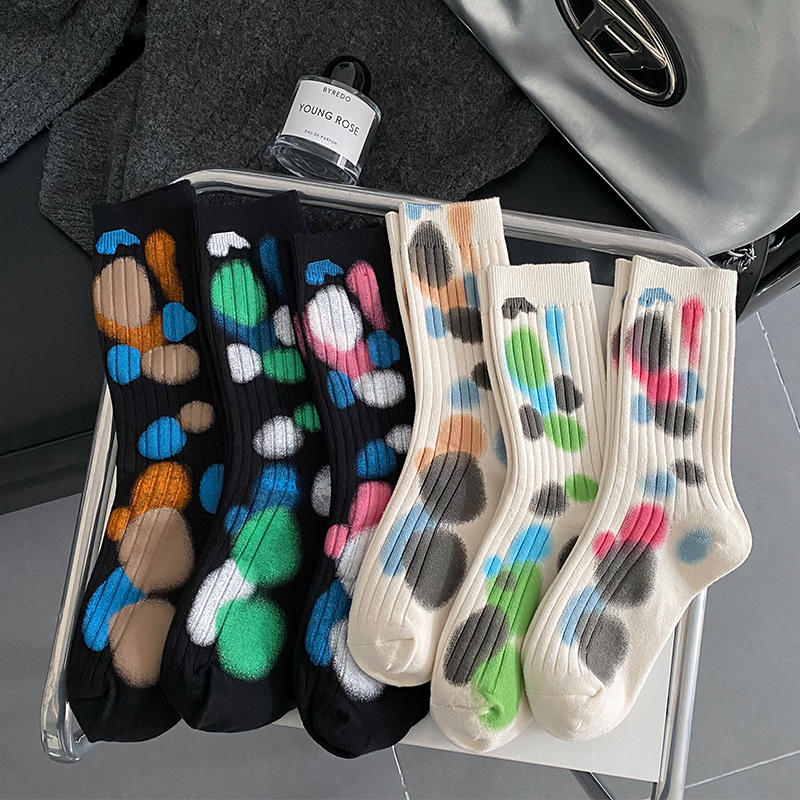
Upstream preparation quietly decides as much as the knitting itself. Yarn that arrives with even tension, clean winding and consistent twist knits into socks with fewer defects and a more uniform hand feel; that is why serious mills invest heavily in winding and twisting equipment before a single sock is made. And where pure cotton meets lifestyle demand, the fibre still carries real charm - a soft, breathable cotton mid-calf sock with a modern tie-dye finish shows how far the "humble" fibre stretches in fashion terms.
Featured style Tie-Dyed Cotton Mid-Calf Sports Socks A cotton mid-calf sock with eye-catching tie-dye work - proof that cotton's softness and colour depth still win attention in casual, low-impact wear. View this cotton style
If you are weighing a cotton specification for your own range, the fastest path is to send us the intended use case and let our knitting team respond with the fibre mix, gauge and structure they would actually run on the floor - including the honest advice that a blend would serve better, when that is the case.
Frequently Asked Questions About 100% Cotton Socks
Is it good to wear 100% cotton socks every day?
Yes, for most people on ordinary days. Cotton is soft, breathable and kind to skin, which suits commuting, office work and home life well. The conditions are simple: your feet are not soaking the sock in sweat, your shoes breathe, and you change socks daily. Add a second or third rotation pair so the cuffs rest and recover between wears.
Are 100% cotton socks bad for sweaty feet?
Generally, yes - they are the wrong tool. Heavy sweat saturates the fibre, the fibre releases that moisture slowly, and the resulting damp film softens skin and feeds odour-causing bacteria. A cotton blend with wicking synthetics, or a performance synthetic sock, will keep sweaty feet noticeably drier and more comfortable.
Do 100% cotton socks cause blisters?
They can, under the right conditions. The mechanism is moisture plus friction: a damp cotton sock clings, wrinkles and loses its glide, and repeatedly rubbing softened skin is how blisters form. For low-sweat daily wear the risk is small; for running or hiking it rises sharply, which is why distance athletes abandoned pure cotton decades ago.
Can 100% cotton socks be stretchy?
Some stretch comes from the knit structure itself, but real, durable recovery needs elastic. Many socks labelled 100% cotton carry a small elastane content only in the cuff, which several labelling rules permit. A truly elastic-free cotton sock will feel relaxed rather than snug and will sit lower on the ankle by evening.
Are 100% cotton socks good for babies?
They are an excellent default. Baby skin is thinner and more reactive than adult skin, and cotton offers softness, breathability and tolerance of frequent hot washing. Focus on the details that matter most at that age: a flat toe seam, a wide non-binding cuff, and a size that does not ring the ankle.
Do cotton socks shrink in the wash?
Uncompacted cotton knits can shrink roughly 3-5% in a first hot wash and dry. Socks that were pre-shrunk during finishing shrink far less, and warm washing with air drying keeps shrinkage minimal across the board. If your socks came out of the laundry a size smaller, heat was almost certainly the cause.
Are 100% cotton socks warmer than synthetic ones?
When dry, cotton insulates adequately and feels comfortably warm in ordinary indoor winter conditions. When damp, the situation reverses: the trapped water pulls heat from skin quickly, making wet cotton one of the coldest things you can wear. For genuine winter and wet-weather warmth, wool outperforms both cotton and synthetics.
How can I tell if socks are really 100% cotton?
Start with the fibre content declaration and any cuff exceptions, then judge by feel - combed cotton is smooth, matte and non-slippery compared with slick synthetics. A burn test on a single yarn end is the classic last resort: cotton burns like paper and leaves soft grey ash, while synthetics shrink away and harden into a bead. For certainty at scale, ask the supplier for fibre-composition test reports.
One rule pulls this whole discussion together: match the sock to the sweat. Dry day, soft shoes, skin that deserves kindness - pure cotton will serve you beautifully, and it has been doing exactly that job since our own knitting lines first ran in 2003. Heavy sweat, long trails or wet winter weather - let a blend, a synthetic or wool take the load, and your feet will register the difference within the first hour. And if you would rather put that decision in front of people who run the machines every day, send us the use case and we will tell you plainly which fibre we would knit and why.

 English
 Español