On a winter night in Zhuji, Zhejiang Province, the indoor air temperature can easily fall to 6–10°C. A sleeping person’s core temperature drops first, the surface blood vessels dilate, and the feet are the first part of the body to feel the cold. Chinese households deal with this nightly event in a simple way: they wear socks to bed. It is not a superstition and it is not a marketing invention. It is a practical method of temperature control that has deep cultural roots and a clear physiological effect.
From the standpoint of a sock manufacturer, the habit raises a more interesting question: which socks are actually suitable for sleeping? A pair designed for outdoor running, with tight compression and dense cushioning, is very different from a soft roomy night sock. Material, stitch type, and fit tolerance decide whether the same “wear socks in bed” routine feels comfortable or becomes a cause of restless sleep. This article explains both sides of the story: why Chinese sleep with socks on, and how textile engineering turns a simple habit into a dependable product.
Why Sleeping with Socks On Is Common in Chinese Households
Many Chinese cities in the Yangtze River region do not have central heating. In winter, indoor temperatures in Nanjing, Hangzhou, Shanghai or Zhuji often stay below 14°C at night, and sometimes fall below 10°C in rural bedrooms. Under such conditions, the foot, an extremity with a high surface-to-volume ratio, loses heat quickly. Keeping it covered is not about fashion; it is about basic thermal comfort.
Traditional Chinese medicine also considers the foot a key area for preserving body warmth. The concept of cold entering through the soles appears in everyday family advice. Elderly family members tell children to protect the Yongquan acupoint at the centre of the sole, and one widely used method is to pull on a clean pair of socks after washing feet at night. This custom is so common that many Chinese children grow up thinking of bed socks as a normal part of winter, just like a quilt or a hot water bottle.
The habit is also supported by a simple daily ritual. Many Chinese prefer to soak their feet in warm water for 10 to 20 minutes before going to bed. The warm water increases local blood flow, the feet feel soft and warm, and a pair of socks helps to keep that warmth from dissipating while the body prepares for sleep. From a manufacturer’s point of view, this means products need to be made from comfortable, breathable materials because the foot temperature inside a sock will stay elevated for hours.
Cold Feet Delay Sleep: What Happens Inside the Body
Sleep onset involves a natural drop in core body temperature. To release heat, the body widens blood vessels in the hands and feet. The feet act as radiators: when the bedroom is warm, they release excess heat quickly and the brain receives a clear signal that it is time to sleep. When the bedroom is cold, the vessels stay narrow, heat is trapped in the core, and the sleep signal is delayed. The result is a familiar pattern: cold feet, longer time to fall asleep, and more nighttime waking.
Most sleep studies show that foot warming of only 0.5–1°C is enough to shorten the time to sleep onset. Warming the foot does not need to raise skin temperature to an uncomfortable level. In practice, the goal is to keep the foot in a comfortable range of roughly 28–34°C without sweating. If a foot becomes too hot and damp, sleep quality drops because of moisture discomfort rather than cold.
Illustrative comparison of typical time to fall asleep; values are rounded for clarity.
This is why a thin pair of ordinary cotton socks can feel like an improvement, but not always the best solution. Cotton absorbs moisture but dries slowly. Once the feet heat up inside a thick cotton sock, the fabric can hold sweat and turn wet. The material and structure of the sock control how the microclimate develops over seven or eight hours of continuous wear.
Material and Knitting Structure: A Factory View of Night Socks
When we evaluate a sock for sleep use, we look at three factors: thermal insulation, moisture transport, and fit pressure. Insulation depends on the amount of still air trapped in the fabric. Moisture transport depends on the fibre type and the orientation of the knit. Fit pressure depends on the elastic yarn and the width profiling of the sock.
Wool is the classic material for night warmth. Wool fibres naturally crimp, which creates small air pockets, and the fibre structure can hold a large amount of moisture vapour without feeling wet. A well-made woollen sock can absorb a considerable amount of moisture before the inner surface becomes damp. During deep sleep, this moisture buffering effect reduces the clammy sensation that occurs with polyester or pure cotton.
Typical material behaviour in nighttime sock use
| Knit or material |
Warmth |
Moisture management |
Skin feel |
Best use at night |
| Wool |
High |
Excellent |
Soft to slightly textured |
Cold rooms, sweaty feet, long sleeping hours |
| Cotton |
Medium |
Medium-low |
Soft and smooth |
Mild bedrooms, people who overheat easily |
| Polyester blend |
Medium |
High |
Smooth |
Dries fast, but avoid very dense structure |
| Double-layer knit |
High |
High |
Very comfortable |
Very cold bedrooms, sensitive sleepers |
Many customers ask why a woollen sock feels warm on some nights and too warm on others. The answer is usually the density of the knit. A heavier loop structure keeps more air next to the skin, which is appropriate when indoor temperature drops below 12°C. For milder rooms, a lighter flat-knitted sock or a wool blend with lower pile provides enough insulation without overheating.
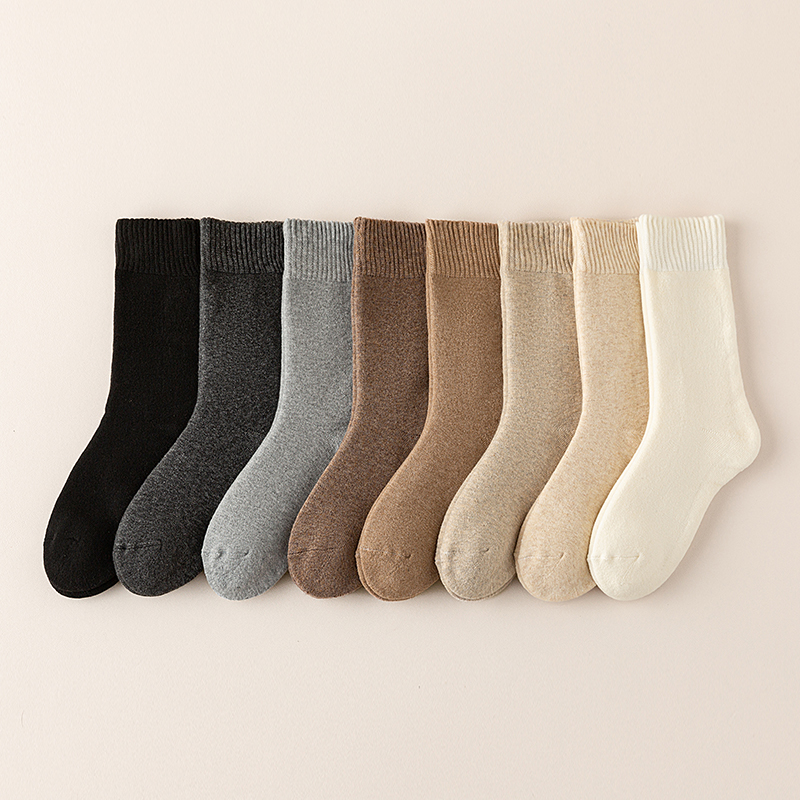 Wholesale Solid-Colored Wool Thermal Socks in Multiple LengthsThese wool thermal socks use a dense knit to trap air for warmth in colder rooms. Available in crew and knee lengths, they suit nights when indoor temperature drops below 12°C.View Product →
Double-Layer and Terry Socks: Two Favourites for Cold Chinese Bedrooms
Another Chinese market favourite is the double-layer sock. As the name suggests, the sock is knitted with two independent layers. The inner layer is usually a soft cotton or cotton-blend fabric against the skin, and the outer layer is a stronger knitted shell. The air gap between the two layers acts as insulation, similar to the principle used in winter jackets, but adapted to the shape of the foot. A double-layer sock can provide reliable warmth without the bulk of a very thick single-layer sock.
Double-layer construction also reduces rubbing against the toe area, which matters for sleepers who move a lot at night. A film of about 2 to 4 millimetres of trapped air is enough to slow heat loss from the foot. When the inner layer becomes slightly damp with sweat, the outer layer still provides a thermal barrier, keeping the overall foot temperature stable. Our earlier article explains how double-layer thermal socks keep feet dry during sleep in more detail.
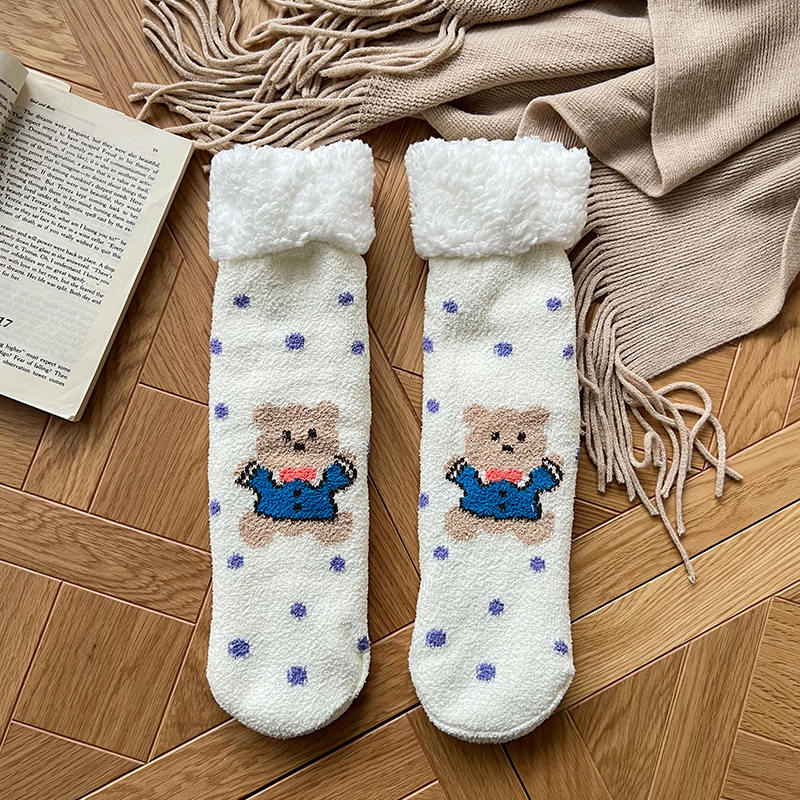 Wholesale Double-Layer Thermal Socks with Cushioning DesignThis double-layer sock features an inner comfort layer and an outer protective shell, trapping air to insulate feet. Ideal for sleepers seeking stable warmth and reduced toe friction.View Product →
Terry socks are a close third option. In a terry knit, looped yarns are pressed outward on the inside of the fabric, creating a surface similar to a soft towel. These loops trap stationary air, which is exactly what feet need in an unheated bedroom. Terry night socks are also forgiving in fit: because the pile is soft, a slightly looser shape feels comfortable rather than baggy. If the sock height extends above the ankle, it helps to cover the Achilles tendon area, another zone where heat is easily lost.
Cultural Differences: Chinese Habits vs. Western Bedroom Norms
Foreign visitors sometimes react with surprise because in many Western countries, sleeping with socks on is associated with discomfort. The explanation lies mainly in indoor heating. In centrally heated homes in Northern Europe or North America, winter bedroom temperatures stay between 18°C and 22°C. At that temperature, feet rarely get cold enough to become a problem. In southern, lower Yangtze or coastal Chinese homes, especially older buildings, bedroom temperatures regularly hover between 6°C and 14°C in January. In that environment, a pair of socks is as practical as long thermal underwear.
The cultural mirror is also visible in the preparation routine. In China, foot-washing before bed is a common health habit, followed by covering the feet with clean socks to preserve the accumulated warmth. In countries with central heating, the routine is less necessary. This does not make either practice superior; it simply reflects different building design and climate.
Comparison is a generalisation; actual conditions vary by region and household.
| Factor |
Typical central-heated home |
Typical Chinese home in Yangtze region |
| Indoor night temperature |
18–22°C |
6–14°C |
| Foot care before bed |
Rarely needed |
Warm foot bath is common |
| Bed socks |
Optional |
Normal part of winter bedding |
| Typical winter feel |
Dry and warm |
Humid and cold |
| Main sleepwear goal |
Light comfort |
Multi-layer thermal protection |
What to Look for in a Sock Designed for Sleep
For anyone selecting a night sock, either for personal use or for a product range, these specification points matter more than colour or branding.
Roomy leg opening, no compression band
A night sock should stay on with mild friction. The elastic cuff should not press above 8 mmHg, otherwise it can leave marks on the ankle and reduce overnight comfort.
Flat toe seam
A raised toe seam can irritate the skin during the long hours in bed. Hand-linked or flat-seam constructions are preferred for sensitive sleepers.
Moderate breathability
Feet release moisture while sleeping. A blend of natural fibre and fast-drying synthetic yarns performs better than a single-material thick fabric.
Dimensional stability after washing
Night socks are washed frequently. The shape should hold after repeated washing; otherwise the sock slides off at night and provides uneven warmth.
When comparing sock types, the table below summarises the practical differences a wearer can expect.
Night sock types at a glance
| Sock type |
Structure |
Warmth level |
Moisture behaviour |
Best suited for |
| Woollen sock |
Natural crimp |
High |
Absorbs moisture vapour |
Cold bedrooms, sensitive sleepers |
| Double-layer sock |
Two independent layers |
High |
Inner layer absorbs, outer layer insulates |
Very cold nights and long sleeping hours |
| Terry sock |
Looped pile inside |
Moderate-high |
Pile buffers moisture |
Unheated bedrooms and cold feet |
| Thin cotton sock |
Flat single layer |
Moderate-low |
Absorbs liquid sweat but dries slowly |
Mild rooms, people who overheat easily |
Terry night socks are especially common in southern Chinese homes because the looped pile feels gentle against freshly washed skin. A medium-height terry sock covers both the heel and the lower calf without restricting ankle movement. The result is a simple layer of protection that works all night without needing adjustment.
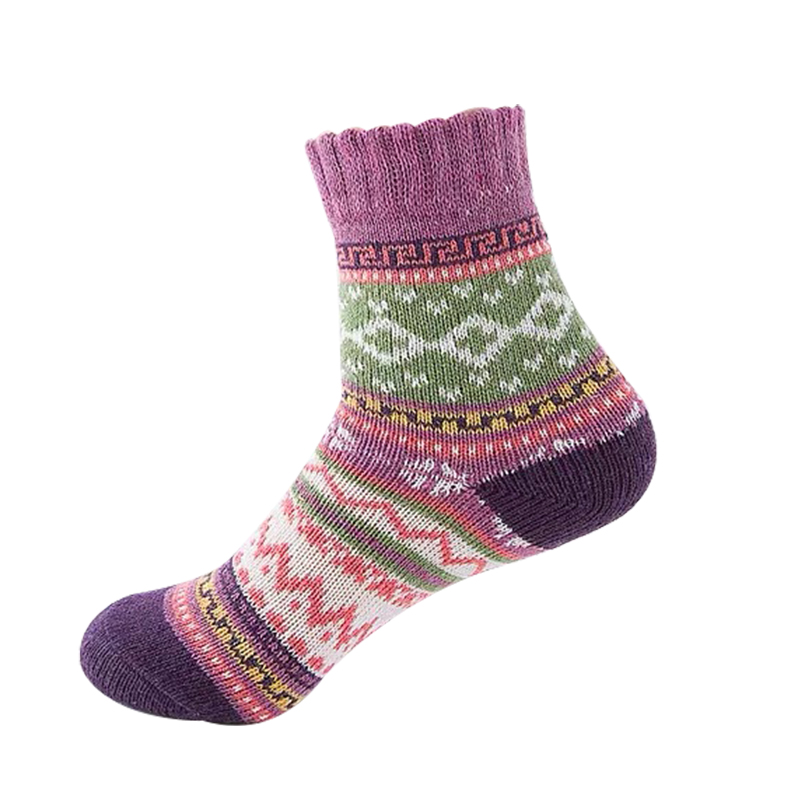 Wholesale Thick Terry Thermal Socks with Plush Loop PileThese thick terry socks have a soft looped inner surface that holds warm air, making them suitable for unheated bedrooms. The medium height covers the heel and lower calf comfortably.View Product →
From Airline Socks to Night Socks: Inside Our Production Floor
Zhuji Lilong Import and Export Co., Ltd. started in December 2003 by making disposable socks for airline passengers. That category set the tone for our factory: small, precise, clean and consistent. The production line grew from about 15,000 pairs per day to 80,000 pairs per day, and the product list today covers woollen thermal socks, double-layer thermal socks, terry socks, sports socks and many special structures.
Our home base is Datang Town in Zhuji, Zhejiang Province, a concentrated hosiery manufacturing area in China. Proximity to yarn suppliers and knitting machine makers gives us flexibility in developing different structures. When a customer asks for a night sock with a specific loop height or leg opening pressure, the nearby supply chain allows faster sampling and reliable repeat production. The same knitting technology is available through the sock knitting machines we also supply to other production facilities.
Quality control for a night sock focuses on weight, stitch density, sock length and cuff elasticity. We measure the finished weight in grams per dozen, check the terry loop density, test the cuff recovery after stretching, and inspect the toe seam by pulling it flat. These may seem like simple details, but they decide whether the sock stays comfortable at 3 a.m. after several hours of movement.
For a factory, the popularity of sleeping in socks is not surprising. It is a logical response to cold rooms, humid winters and a cultural preference for protecting the feet. From our point of view, the best night sock is not the thickest one; it is the one with the right material, the right structure and the right fit for a specific sleeping environment.
Frequently Asked Questions About Sleeping with Socks On
Is it healthy to wear socks all night?
For most adults, yes. A breathable, non-compressing sock keeps feet warm without restricting circulation. The main risk is wearing socks that are too tight, too thick or made from non-breathable synthetic yarn, which can create dampness and overheating. Choose a loose fit with a low-pressure cuff.
Can compression socks be used overnight?
Compression socks are designed for use during the day, mainly to support veins and reduce swelling. They are not the same as sleep socks. Wearing a high-compression sock overnight is usually unnecessary and can feel restrictive, especially for healthy sleepers.
Do woollen socks feel itchy in bed?
It depends on the wool grade and the finishing process. Fine merino wool or blended wool can feel soft against the inner foot. The knitting structure matters, too: a loose-knit wool sock tends to feel more comfortable than a tightly spun thick fabric.
Why do Chinese people use a hot-water foot bath plus socks?
The combination extends the period of increased blood flow. Warm water relaxes the foot and boosts circulation, and then socks keep the heat on the skin long enough for the body‘s sleep mechanism to engage. Without socks, the foot can cool down again within 15 to 20 minutes.
Should children wear socks when sleeping?
In unheated rooms, young children often need a lightweight cotton or wool mix sock to maintain stable foot temperature. The sock should be fully loose around the ankle and the toe area. If the child’s room is heated above 20°C, socks are usually unnecessary.
How often should night socks be washed?
Wash every two to three days, or more often in humid weather. Use water below 40°C, avoid fabric softeners because they flatten the crimp and reduce thermal insulation, and dry flat to keep the loop structure intact.
The Sock Decision That Changes Sleep Quality
If you share a bedroom with temperature fluctuations, the choice of a night sock is a microclimate decision. A sock that is too thin does not retain enough heat. A sock that is too thick makes the feet sweat. The sweet spot is a knitted layer that traps air, wicks moisture away from the skin, and stays in place without compression marks.
From our time on the production floor, we have found that the best sleep sock designs are also the easiest to produce consistently: moderate loop height, reliable yarn choice, a low-pressure cuff, and a smooth toe. These details are not only for consumers. Retailers, brand houses and distributors who source from our factory use the same thickness, gram weight and pressure specifications to build products that solve a genuine nighttime problem.
So the reason why Chinese sleep with socks on is not a mysterious preference. It is climate, culture and physiology working together. Once you understand how the foot loses heat at night, a simple knitted sock becomes one of the most effective sleep aids available. The right sock does not promise instant sleep, but it removes one common obstacle between you and a stable night’s rest.

 English
 Español