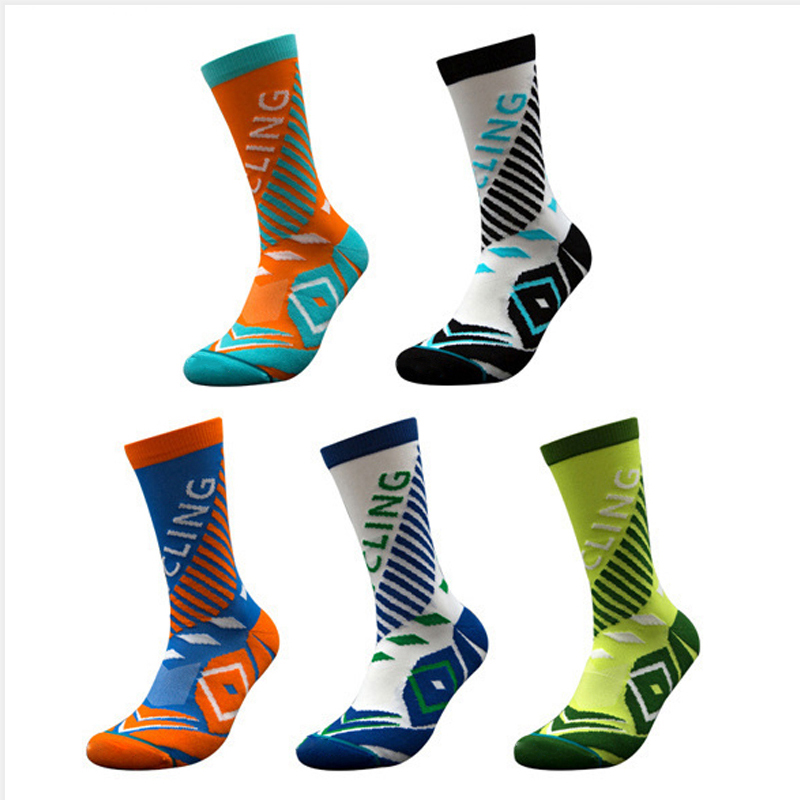
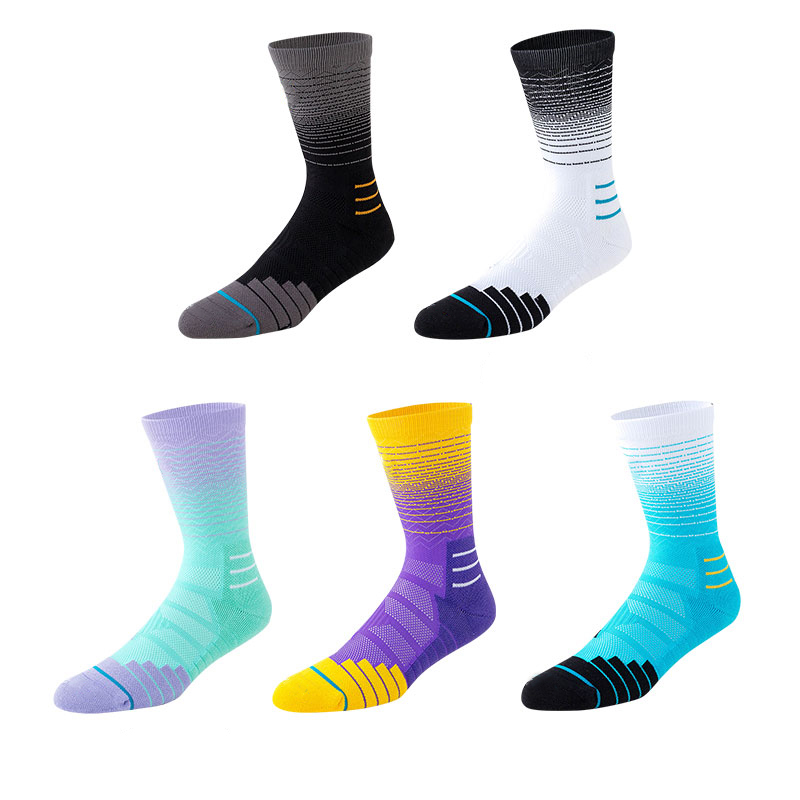
Why You Can't Just Wear Running Socks for Cycling
While running and cycling are both high-intensity aerobic exercises, the biomechanics of the foot are completely different.
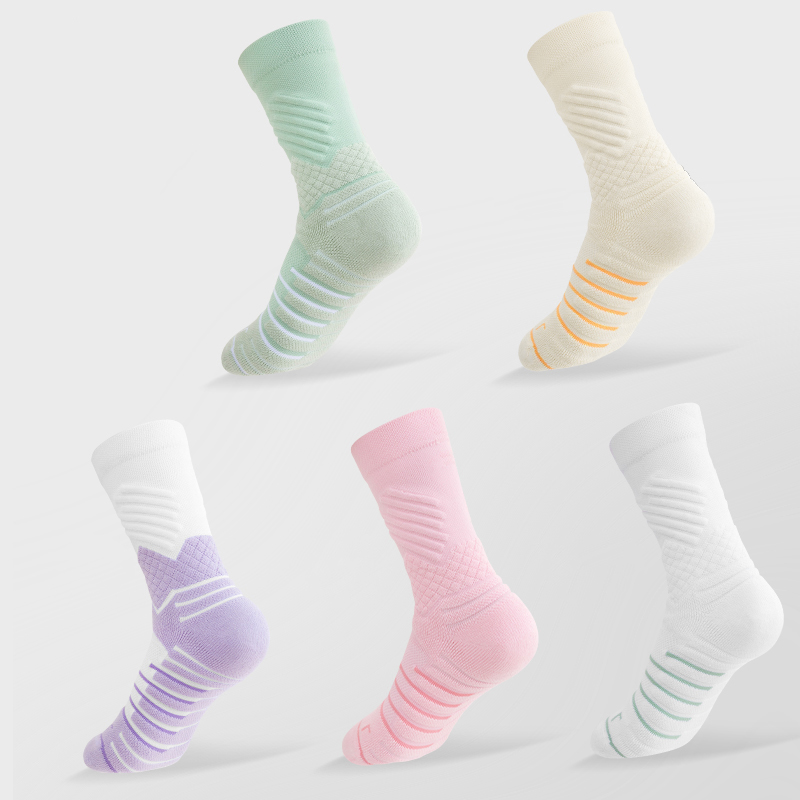
Running is a typical impact sport. With every step you take, your foot absorbs several times your body weight in impact. To handle this pressure, running socks are designed around "shock absorption" and "space filling." They usually feature thick terry loops at the heel and forefoot, acting like a sponge to absorb the impact of landing.
In contrast, cycling is a closed power transfer process. Your feet are locked into stiff cycling shoes, performing circular pedaling. During this process, the foot does not need to absorb direct impact from the ground. The design logic of Cycling Socks is "ultimate power transfer" and "eliminating gaps."
Core Difference: Impact vs. Transfer
- Running Socks Logic: Adding cushioning layers to protect joints and filling gaps in running shoes to accommodate the foot's rolling motion.
- Cycling Socks Logic: Eliminating thickness to reduce foot slippage inside the shoe. In cycling, any excess fabric thickness acts like a "soft pad," wasting the power feedback when you push down on the pedals.
Technical Parameter Comparison: Running Socks vs. Cycling Socks
| Performance Dimension |
Running Socks |
Cycling Socks |
| Main Function |
Impact absorption, blister prevention |
Power transfer, aerodynamics, precision fit |
| Fabric Thickness |
Medium to thick (heavy terry cushioning) |
Extremely thin (Ultralight), "second skin" feel |
| Structural Design |
Full-sole or targeted padding |
Flat-knit, almost no extra padding |
| Fit |
Comfortable wrap, allows stretching |
High-compression fit, prevents shifting |
| Ventilation Focus |
All-around breathability for heat |
Mesh Tops, uses oncoming wind to cool |
| Toe Seam |
Fine flat seam |
Seamless design, prevents pressure in shoes |
Core Structure and Cushioning Showdown
In terms of sock construction, running socks and Cycling Socks follow opposite paths due to different "force points" during exercise.
Running Socks: Full-Foot Protection and Space Filling
Running involves a cycle of "landing-supporting-pushing off," and the sole endures pressure from multiple angles.
- Multi-point Cushioning: Usually designed with obvious terry looping in the heel, toes, and forefoot to alleviate plantar fascia fatigue.
- Abrasion Prevention: Thickened fabric acts as a lubricant between the foot and shoe inner wall, reducing friction-induced blisters.
Cycling Socks: Precise Feedback and Zero Obstruction
For cyclists, the critical contact point is the "ball of the foot" under the big toe—the key for transferring power to the pedals.
- Minimalist Structure: Most areas of Cycling Socks use a flat knit with almost no thickness to integrate the foot tightly with the stiff shoe sole.
- Power Zone Treatment: High-quality Cycling Socks may have an extremely thin reinforcement layer only in the ball area to provide protection without sacrificing road feel.
- Arch Support Band: The midfoot is equipped with high-elasticity compression bands to ensure the sock stays tightly against the skin without bunching during high-cadence pedaling.
Structural Parameter Comparison: Internal Knitting Craftsmanship
| Structural Parameter |
Running Socks |
Cycling Socks |
| Sole Terry Loop |
Common, thickness 1.5mm - 3mm |
Rare, thickness usually below 1mm |
| Toe Reinforcement |
Focuses on durability against toe-through |
Focuses on flattening to prevent pressure |
| Arch Compression |
Moderate, aids blood flow |
High compression, ensures no shifting |
| Ankle Knit |
Softer for comfort and protection |
Tight and elastic to reduce fabric bunching |
| Force Distribution |
Evenly distributed across the sole |
Highly concentrated at the forefoot |
Cuff Height and Aerodynamics
In running, cuff height is a matter of aesthetic; in cycling, Cycling Socks height involves Aerodynamics.
Running Socks: Flexibility and Lightweight
A runner's leg movement is a longitudinal swing. A cuff that is too high might restrict the natural contraction of the calf muscle.
- Low-Gravity Design: Mostly no-show or quarter-length to minimize weight and maintain ankle flexibility.
- Single Function: Prevents the shoe collar from rubbing the heel and keeps debris out.
Cycling Socks: The Secret Weapon for Drag Reduction
When speeds exceed 30km/h, air resistance is the biggest obstacle. The lower leg creates significant turbulence as air passes.
- Physical Drag Reduction: Modern high-performance Cycling Socks use extended heights and special "striped" or "honeycomb" weaves to guide airflow smoothly.
- Surface Texture: These textures induce the transition to turbulent flow earlier, reducing the low-pressure wake behind the leg.
- UCI Rules: Drag reduction is so significant that the UCI stipulates cuff height cannot exceed half the distance between the fibular head and the lateral ankle bone.
Performance Parameter Comparison: Aerodynamic Impact
| Parameter/Feature |
Low-cut Running Socks |
Standard Cycling Socks |
Aero Cycling Socks |
| Typical Height |
0cm - 5cm |
15cm - 20cm |
18cm - 23cm |
| Fabric Surface |
Flat or textured terry |
Tight and fine |
Grooved or aero lines |
| Drag Performance |
High (exposes more skin) |
Medium |
Lowest (via surface engineering) |
| Anti-slip |
Ribbed cuff |
High-elastic fibers |
Silicone grippers |
| Watt Savings |
0W |
Approx. 1W - 2W |
Up to 3W - 8W |
Wicking and Temperature Control: The Secret to Staying Dry
The feet are main heat-dissipation organs. Moisture management differs due to the environment of each sport.
Running Socks: Vertical Pumping and All-around Wicking
Running creates a "pump" effect, pushing hot air in all directions through the sock fabric.
- Omnidirectional Breathability: Needs breathable fibers throughout because sweat saturates the thick terry layers and must be pushed out through physical pressure.
- Thickness Challenges: Must have high moisture capacity, otherwise a soaked layer will increase friction and cause blisters.
Cycling Socks: Wind-Face Cooling and Wake-Side Heat Dissipation
Cycling Socks logic is built on "oncoming wind." The instep is the primary wind-facing surface.
- Engineered Mesh Instep: Most use a thin, large-hole mesh on the instep, allowing wind to penetrate and strip heat from the skin instantly.
- Rapid Drying: Uses synthetic fibers that absorb almost no water, ensuring sweat evaporates rather than being stored in the fabric.
Temperature Control Parameter Comparison: Moisture Management
| Parameter |
Running Socks |
Cycling Socks |
| Primary Cooling |
Wicking + Pump-action venting |
Convection cooling (Wind) |
| Mesh Distribution |
Localized or full-sole knit |
Large-area mesh on the instep |
| Water Absorption |
Low |
Extremely low |
| Drying Speed |
Slower (due to layers) |
Extremely fast (single-layer) |
| Weight (Pair) |
40g - 60g |
20g - 35g |
Compression and Ankle Support
Compression prevents fatigue and protects joints, but zones differ based on impact versus repetition.
Running Socks: Dynamic Support and Arch Protection
The arch repeatedly stretches and collapses with every step during a run.
- Arch Support: Provides moderate circular compression to help the plantar fascia reduce its load.
- Ankle Protection: Reinforced fabric density around the ankle provides proprioceptive support to help prevent sprains.
Cycling Socks: Static Stability and Circulation Promotion
Cycling involves prolonged vascular pressure rather than longitudinal deformation.
- Extreme Fit: Ensures "zero bunching" so no folds create pressure points inside the stiff shoe.
- Blood Flow: Uses graduated compression—strongest at the ankle—to help blood return from the extremities and reduce swelling.
Compression Technical Parameter Comparison
| Compression Parameter |
Running Socks |
Cycling Socks |
| Core Zone |
Arch, around the ankle |
Arch, entire cuff |
| Pressure Intensity |
10 - 15 mmHg |
15 - 25 mmHg |
| Stretch |
Four-way stretch |
Two-way high elasticity |
| Edge Design |
Soft ribbed cuff |
Raw-cut or silicone grippers |
| Main Purpose |
Alleviate fatigue, prevent sprain |
Optimize power, aid circulation |
Buyer's Guide: Choosing the Right Cycling Socks for Your Ride
Match your Cycling Socks choice to your specific riding scenario:
Road Racing
- Focus: High cuffs, aerodynamic textures, and extreme lightweight.
- Requirement: Synthetic blend with elastane to ensure zero movement at high speeds.
Gravel/Endurance
- Focus: Micro-cushion layer on the sole for comfort over vibration.
- Requirement: Blends containing Merino wool for antibacterial properties over long hours.
Indoor Training
- Focus: Largest possible mesh area on the instep.
- Requirement: Maximum evaporation rate since there is no natural wind indoors.
FAQ:
- Q: Why do Cycling Socks feel less "comfortable" than running socks?
A: Running socks aim for soft touch, while Cycling Socks aim for a "second-skin" feel and efficient power feedback; they are functional parts, not just clothing.
- Q: Can I use short running socks for entry-level cycling?
A: Yes, but on rides over 50km, the thickness may cause overheating and lack of arch support.
- Q: How long do Cycling Socks usually last?
A: They often outlast running socks because they don't endure ground impact. Avoid walking in them without shoes to preserve the thin sole.
- Q: Why are many cycling socks labeled with "Left/Right foot" designs?
A: To follow the specific anatomical structure of each foot, removing excess material for the ultimate fit inside a tight shoe.

 English
 Español